Author: Frederic

  • REMI: a critical tool in Health and Social Care Reform

    REMI: a critical tool in Health and Social Care Reform

    As we mark the anniversary of the Race Equity Maturity Index (REMI), its importance to the future of the NHS is undeniable. Developed by the Race Equality Foundation through the London Anti-Racism Collaboration for Health (LARCH), REMI is the first evidence-based self-assessment tool enabling health and care organisations across Greater London to track, measure, and strengthen their commitment to race equity. 

    Why REMI Matters in Health and Social Care Reform

    The NHS – and, at a slower pace, social care – is undergoing significant transformation amid growing political pressure to boost productivity and ensure financial sustainability. During times of major change, equality initiatives are often treated as optional when savings need to be made, especially with rising public criticism of equality, diversity and inclusion (EDI) efforts. Yet cutting back on EDI when building an NHS for the future is a false economy. 

    London’s health and care system reflects the UK’s diversity; over one-third of NHS staff come from Black, Asian, and minoritised ethnic communities. However, these staff continue to experience harassment, discrimination and barriers to career progression despite years of commitments to change. And patients from minoritised ethnic communities continue to face poorer health outcomes. 

    A successful NHS is one where staff not only stay, but feel like they belong and thrive;  and where fair and effective care is accessible to all. 

    To meet the needs of an increasingly diverse population and workforce, equity must be front and centre of planning, otherwise we risk persistent racial health inequalities and workforce disparities deepening.

    REMI ensures race equity is not an optional add-on but is integral to organisational culture and governance, helping to deliver fairer and more trusted care for all. 

    A System-Wide Approach

    Dismantling structural racism in health and care requires collective action and shared responsibility. REMI supports whole-system alignment across NHS organisations, Integrated Care Systems, local authorities, public health teams, and voluntary and community sector partners, reflecting the collaborative approach taken in its design.  

    It provides a structured six-stage pathway for organisations to embed anti-racist practice at every level: 

    1. Awareness: recognising racism as a systemic issue.
    2. Commitment: developing a clear race equity strategy.
    3. Implementation: turning strategy into measurable action.
    4. Embedding: Aligning policies and decision-making with anti-racist principles.
    5. Creating: Innovating to address racial disparities.
    6. Championing: Organisations leading the way for others.

    One early adopter noted: REMI allows one to gauge where they are in tackling racism. It provides objectives that organisations can work towards, and it underscores that tackling racism is an ongoing process.”

    It has been created to complement existing EDI efforts across Greater London, so health and care organisations are able to move from compliance toward cultural transformation. 

    Designed for Today’s Challenges

    REMI was designed to address the realities health and social care leaders face: 

    • Initiative Fatigue: REMI consolidates existing frameworks – Workforce Race Equality Standards (WRES), Workforce Disability Equality Standards (WDES), CQC standards, and Public Sector Equality Duty (PSED) requirements – by providing an overarching structure to connect existing equality work.  As one NHS practitioner observed: This [REMI] looks at the anti-racism side of things from a different angle. And that’s why I think it can complement what you’re doing in the WRES. REMI could be part of your arsenal with the WRES.” REMI allows you to structure what you’re already doing into a coherent narrative that demonstrates genuine progress.
    • Capacity Constraints and Competing Priorities: REMI is flexible and non-prescriptive. There are no external deadlines or mandatory reporting requirements imposed by NHS England. Organisations move through the maturity stages at their own pace, integrating race equity into existing board priorities rather than creating parallel streams of work. This reduces pressure on already-stretched leaders while ensuring equity remains embedded in core business.
    • Fear of Naming Racism: REMI’s systems-focused approach addresses institutional structures rather than individuals, creating the space for honest conversations about racism without triggering defensive responses. This makes change feel achievable rather than accusatory.
    • Poor Data Infrastructure: REMI strengthens ethnicity data systems by requiring organisations to examine the processes that affect data quality – such as recruitment, decision-making pathways, and reporting structures. This helps to build the evidence base needed to demonstrate progress, identify where change is needed, and drive meaningful change.
    • Low Staff Trust: Years of statements without structural change have left many staff of minoritised ethnic backgrounds skeptical about new initiatives. REMI moves organisations from statements to structural actions. It focuses on visible, tangible changes: fair recruitment pathways, meaningful staff engagement, and community co-production. Staff can see where their organisation is in its journey and what specific actions are being taken at each stage. This transparency rebuilds trust through evidence, not promises. 

    The Strategic Case for REMI

    REMI is more than a moral imperative – it’s a strategic investment. NHS workforce data shows that staff who experience discrimination are significantly more likely to leave the organisation and report lower engagement. The evidence is clear: equitable and inclusive organisations deliver better patient outcomes, foster greater innovation, and build stronger organisational resilience. REMI provides the measurable progress indicators, and accountability to embed race equity practices that build these inclusive conditions.

    As the NHS reforms to become more integrated and responsive to community needs, tools like REMI are essential to ensure that equity is at the heart of transformation – not an afterthought. REMI helps organisations demonstrate their commitment to race equity through real improvements to staff experience, organisational culture, and patient outcomes.

    Join the Movement

    On this anniversary, we call on health and care organisations to put your commitment to race equity into practice with the REMI tool, designed for the reality you face. 

    REMI offers a structured, evidence-based pathway that identifies where you are and supports steady, sustainable progress.

    Whether you’re at the beginning of your journey or already implementing anti-racist strategies, REMI provides the framework to assess your current position, identify next steps, and demonstrate your progress to staff, patients, and communities.

    The challenges facing London’s health and care system are significant, but so is the potential for transformation, with the right tools and support.

    Learn more and access the REMI framework: Race Equity Maturity Index

    Have questions about how REMI could work in your organisation? Get in touch.


    REMI was developed by the Race Equality Foundation as part of the London Anti-Racism Collaboration for Health (LARCH), with support from the Greater London Authority and Health Innovation Network South London.

    Dr. Amanda Simon is a Senior Researcher at the Race Equality Foundation, focused on anti-racism policy and implementation, working closely with community partners and individuals from Black, Asian, and minoritised ethnic communities.
  • The origins of LARCH

    The origins of LARCH

    Racial health inequalities in London are not new. While racism and discrimination have shaped health outcomes for Black, Asian and minoritised ethnic communities for decades, awareness and evidence has grown since the 1970s.

    The establishment of the NHS and the arrival of the Windrush Generation and migrants from Asia, Africa and beyond brought greater diversity to the city, but also highlighted barriers to
    care. As access improved, previously hidden disparities in disease prevalence and outcomes became more visible.

    Over time, targeted interventions – such as culturally informed care for sickle cell disease which is more prevalent in people with African or Caribbean heritage – have begun to build momentum in London, showing how tailored approaches can reduce inequalities.

    Racism as a public health priority

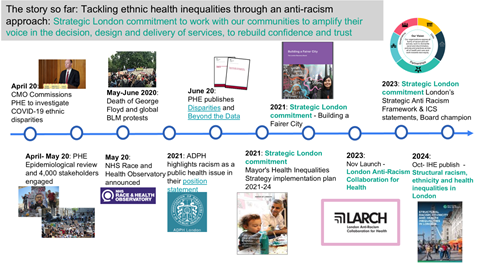
    In 2020, two events prompted an overdue focus on ethnicity related health inequalities and the impact of structural racism – ie. the discrimination and disadvantage built into many of our structures, systems and institutions. The Covid-19 pandemic brought the whole world to a halt, and the national health and care system to the brink of collapse. Almost from the outset, it was clear that Black, Asian and minoritised ethnic Londoners were bearing the brunt of the disease, being more likely to become hospitalised and more likely to die with the Covid-19 virus.

    The pandemic’s devastating impact was heightened by the toll it took on London’s highly diverse health and social care workforce; 45% of NHS staff in London identify as being of Black, Asian, or minoritised ethnic heritage. During the first wave in 2020, 64% of all nurses and support staff who died during the pandemic were from minoritised ethnic groups, with the number rising to 95% for doctors.

    The summer of 2020 also saw the murder of George Floyd, sparking protests across the world and the rise of the Black Lives Matter movement. These protests fuelled new discourse on structural and systemic racism – bringing greater acknowledgement of the negative impacts of social and environmental inequities on many facets of life for minoritised ethnic groups. It also saw greater recognition that designing solutions for these complex problems requires collaboration – not only across sectors, but also in genuine partnership with those most affected by discrimination.

    The response to these events from the health and care sector was wide-ranging. At an operational level, a new wave of co-produced health interventions delivered positive results, with campaigns tackling vaccine hesitancy in Black, Asian and minoritised ethnic groups seeing particular success.


    At a more strategic level, significant developments were also taking place, including:


    ● The Association of Directors of Public Health London (ADPHL) publishing a position statement identifying racism as a public health issue (2021).

    ● Public Health England publishing two major reports into the impact of the pandemic on minoritised ethnic groups, Disparities (2020) and Beyond the Data (2020).


    ● The establishment of the independent NHS Race and Health Observatory (2021).

    Learning from the pandemic and building a more equitable London


    Recognising the urgency of reducing racial health inequalities, the Mayor of London developed a set of major strategic commitments in response..

    The Mayor’s Health Inequalities Strategy Implementation Plan (2021) set out a bold vision for collaborative programmes addressing many of the social determinants that underpin racial health inequalities, as well as a commitment to working with partners to identify further
    targeted action. In parallel, the Building a Fairer City initiative mobilised employers, educational establishments, councils and other bodies to play their part in creating a more equitable London, targeting structural causes of inequality .

    The London Health Board was quick to take on recommended action – appointing a champion for race equity to the Board. With a clear commitment to action across health and care partners – including the NHS, Integrated Care Boards, London Councils, ADPHL and the Mayor of London – a three-pronged approach to London action was taken forward Strategy, evidence and action. This programme was informed by the voices heard to date from a diverse section of London’s communities.

    In 2023, the London partners published the Strategic Framework for Tackling Health Inequalities through An Anti-Racist Approach, an ambitious and action-focused framework setting anti-racist expectations for organisations at every level of health and care. To make sure the evidence for action was crystal clear. in 2024 The Institute of Health Equity, published their landmark evidence review – Structural Racism, Ethnicity and Health Inequalities in London . This review of evidence and interventions gave new voice to the evidence collected over many years by academic, health and voluntary and community sector partners about the importance of tackling racism as a determinant of health. “Tackle racism, discrimination and their outcomes” was cemented as the 7th principle in the well established “Marmot Framework” for action on health inequalities

    Thirdly, was the investment in action. In November 2023 the London Anti-Racism Collaboration for Health (LARCH) was launched, with a focus on supporting and accelerating action across London health and care organisations to tackle health inequalities through embedding anti-racist approaches; turning evidence into action and supporting delivery of the framework Designed in coproduction with communities, the LARCH was developed signed to break down silos and improve collaboration between the people, service and structures that make up London’s health and care ecosystem, and accelerate action across the city. The LARCH will help to drive the anti-racist progress that is so desperately needed by Black, Asian and minoritised ethnic Londoners.

  • Co-produced recommendations for London addressing structural racism as a driver of health inequalities

    Co-produced recommendations for London addressing structural racism as a driver of health inequalities

    The Race Equality Foundation has facilitated the co-development of recommendations to address structural racism in London. The recommendations were informed by the Institute of Health Equity evidence review on Structural Racism, Ethnicity and Health Inequalities in London.

    The co-production process has involved work with voluntary and community sector, people with lived experience, and statutory partners (London Councils, NHS, Public Health and GLA group). This work demonstrated the importance of co-production approaches with communities. This is a key learning point from the COVID pandemic and core to approaches on tackling structural racism.

    Using the World Health Organization’s conceptual framework, recommendations were developed through a life course approach. This method pinpoints ‘key opportunities for minimising risk factors and enhancing protective factors through evidence-based interventions at key life stages, from preconception to early years and adolescence, working age, and into older age’. The framework has been applied across four key stages:

    • Starting well
    • Living well
    • Recovering well
    • Ageing well

    Read Co-Produced Recommendations

    Supporting Information for Recommendations

    On Monday 30th June, the Race Equality Foundation hosted a webinar launching the co-produced recommendations, alongside partners from Greater London Authority, Institute of Health Equity, ADPHL London and Design Working group.

    Watch the full webinar below:

    Speakers include:

    Jabeer Butt, CEO, Race Equality Foundation

    Karen Steadman, Senior Manager Health Inequalities, Greater London Authority

    Dr Jessica Allen, Deputy Director, Institute of Health Equity

    Tracey Bignall, Director of Policy and Engagement Race Equality Foundation

    Tumu Johnson, Design Working Group

    Safia Marcano, ADPHL ADPH London Programme Manager, Tackling Racism and Inequality Programme

  • REMI Implementation Infographic: Quarterly updates and progress

    Our new quarterly infographic provides a snapshot of how London’s health organisations are adopting and implementing the Race Equity Maturity Index (REMI).

    While initially created to report to our funders, this work also reflects our broader commitment to transparency, shared learning, and system-wide change. By combining data on downloads, implementation status, and reach across the sector, the infographic offers a clear, visual picture of progress and highlights areas for growth.

    View REMI Implementation Infographic

    Developed by the Race Equality Foundation, REMI is a tool designed to support health bodies in assessing and advancing their racial equity practices.

  • Racial health inequalities across London: A summary of the evidence

    Racial health inequalities across London: A summary of the evidence

    Racial health inequalities persist as a significant concern across the UK, with ethnic minoritised communities experiencing disproportionately poorer health outcomes compared to their white counterparts. For instance, Black women are three times more likely to die during pregnancy and childbirth compared to white women. A recent study has found that repeated exposure to racism leads to increased disadvantage and poorer health outcomes throughout life. Despite being one of the UK’s most diverse cities, London is no exception to this rule.

    In London, structural racism continues to affect the health of ethnic minoritised communities. For example, individuals from South Asian backgrounds have been found to have lower participation rates in cancer screening programmes, resulting in delayed diagnoses and poorer outcomes. People from ethnic minoritised groups, who were also born in the UK, suffer the negative repercussions of structural racism too – with the increasing rate of poor health directly correlating with the length of residence in the UK

    While racial health inequalities are a recognised issue in London, there is still very little research that looks clearly at health inequalities in London through the lens of race. As a result, the information in this resource has been brought together from different places, including national health reports, local council and borough documents, and forward planning reports from Integrated Care Boards (ICBs). Together, they help show a wider picture of the inequalities faced by different racial and ethnic groups in London.

    Racial health inequalities in London by disease:

    1. Maternity 
    1. Infectious disease
    1. Diabetes
    1. Cardiovascular disease
    • In Tower Hamlets, there is a high correlation between unemployment and coronary heart disease (CHD), which is most prevalent in the Bangladeshi population. Microsoft Word – CHD JSNA Factsheet
    1. Respiratory disease
    1. Obesity
    1. Mental Health 

    Structural racism and socioeconomic inequalities contribute to higher rates of mental health issues among ethnic minoritised groups.

    • In 2021, the percentage of residents in Lambeth who rate things they do in their life as worthwhile (positive – scores 9–10) was significantly lower amongst Black, Asian, and Multi-Ethnic residents in comparison to white British residents (55% and 74%, respectively). State of the Borough 2022
    • In 2022, London had the largest unemployment rate difference between white people (8%) and people from the Pakistani and Bangladeshi ethnic group (5%). Unemployment – GOV.UK Ethnicity facts and figures
    • Black people (self-identified and officer-observed) are stop and searched 5.5 times more often than white people. The rate is 1.4 times higher for Asians (self-identified) compared to their white counterparts. (Why) do Londoners back stop and search? – StopWatch
    1. Cancer 
    • In Southwest London, those who identify as Black or Asian, with an existing long-term condition, or from the LGBTQI+ community are less likely to come forward with cancer symptoms within 3 months. SWLICBJFP_June2023Final.pdf

    If you are aware of any additional statistics, research, or localised insights that highlight racial health inequalities in London, we encourage you to share them with the Collaboration. Your contributions will help strengthen this resource and support a more accurate, inclusive understanding of the issues at hand.

  • The 2025 Annual LARCH Learning and Engagement Conference

    The 2025 Annual LARCH Learning and Engagement Conference

    On Friday 7th March 2025, the London Anti-Racism Collaboration for Health (LARCH) convened leading health and care professionals, policymakers, and community leaders to explore challenges and opportunities to drive systemic change in tackling health inequalities in the London regions. Delivered in partnership with the Race Equality Foundation and Health Innovation Network South London, the conference provided a platform for collaborative discussions on embedding anti-racist practice in health and social care. 

    From these discussions key themes emerged throughout the day, underlining the priority areas for action:

    •  Delivering impactful EDI initiatives in a globally challenging environment. Using high-quality data and real-world evidence to demonstrate progress and value for our work is more critical than ever. 
    • There has been clear progress in the development of inclusive public health programmes, workforce initiatives, and the development of best practice frameworks like PCREF and REMI. The next challenge is scaling to a whole-system approach and ensuring all our population benefits from best practice.
    •  We must co-produce solutions with communities, embedding care and services in spaces and places people already use and trust.

    The conference was chaired by Dame Marie Gabriel CBE, Independent Chair at the NHS Race and Health Observatory. Delegates were welcomed with a powerful opening remark by Dr Debbie Weekes-Bernard, Deputy Mayor for Communities and Social Justice, reasserting how LARCH is not just a platform for dialogue, but a catalyst for action, championing anti-racism as both a moral imperative and necessary act of leadership in the face of global threats to equity and inclusion. 

    Professor Peter Goldblatt, Senior Adviser at Institute for Health Equity, examined structural racism in healthcare and disparities in ethnicity data, emphasising how intersectionality, migrations patterns, and systemic inequalities shape health outcomes.  Building on the discussion, Professor Kevin Fenton, Regional Public Health Director at NHS London, underlined the need for data-driven, systemic approaches that embed anti-racism in leadership, workforce diversity, and community engagement in his keynote address.  He acknowledged the challenges of this work but offered an important reminder “We are undoing ways of thinking, ways of being, and ways of interacting with each other, it will take time, but we must stay committed.” 

    Jabeer Butt OBE, Chief Executive at the Race Equality Foundation, chaired the panel discussion on anti-racism strategies. The discussion highlighted the need for stronger relations and collaboration across sectors, including police and education, to address broader social determinants of health. Key themes included leveraging available data to inform decision-making, building trust through community outreach, and using personal privilege, leadership and existing resources to challenge systemic inequalities. 

    The afternoon session drew a full house and maintained the positive atmosphere and engagement from the morning. With a focus on practical applications, delegates explored best practices through six in-depth workshops and real-world case studies. Reflecting on the event, Janine La Rosa, Chief People Officer NHS reinforced the collective responsibility to turn insights into practice. Dame Marie Gabriel CBE closed the conference by delivering a call to keep “moving purposely forward, in unity and even greater determination”.

    Resources:

    Speaker presentations:

    Structural Racism, Ethnicity and Health Inequalities in London – Peter Goldblatt

    From Theory to Action – Professor Kevin Fenton

    Workshop Presentations:

    What, why and how the of the Race Equity Maturity Index (REMI) – Amanda Simon

    Building Trust & Effective Engagement – Strategies for meaningful community partnerships. – Adeola Agbebiyi  & John Licorish

    Towards mental health equity: insights from policy and practice – Kadra Abdinasir

    Addressing racial disparities in maternal and infant mortality – Nandi Simpson and Helen Sheldon

    HIN’s Anti-Racism Journey – Catherine Dale

    View photos from the day

    View photo gallery

  • Core Managers Training Programme

    Core Managers Training Programme

    The Core Managers Training Programme is an inclusive leadership course designed to benefit any manager or supervisor working in health or social care in London.

    Originally created by the NHS London Workforce Equality and Inclusion team, the programme consists of online, self-directed training which can be completed flexibly.

    Across six courses, managers on the programme can develop their skills and confidence leading diverse teams in an equitable, inclusive and compassionate way:

    • Inclusive leadership – covering the basics of Equality, Diversity and Inclusion (EDI), the importance of inclusive leadership, and learning and applying inclusive leadership strategies
    • Creating a psychological contract – introducing the concept of psychological contracts and introducing them in the workplace
    • Noticing and challenging microaggressions – identifying microaggressions and their consequences for teams and individuals, and developing a toolkit to respond to these issues
    • Effective allyship – learning how to support and champion marginalised groups
    • Increasing disability positivity – exploring the legal concept of disability, challenging outdated models of disabilities and understanding the vital role of the line manager in supporting colleagues with disabilities
    • Leading inclusivity: LGBTQIA+ essentials – understand the history of the LGBTQIA+ movement, reflect on intersectionality and use this knowledge to foster inclusivity at work and drive social change

    Each of the course is available free to anyone working in an NHS, public health or social care role. You can apply on the NHS Leadership Academy website.

  • Advancing anti–racism in health and care: introduction to the Race Equity Maturity Index (REMI)

    Advancing anti–racism in health and care: introduction to the Race Equity Maturity Index (REMI)

    It is well evidenced that racism has a detrimental effect on individuals physical and mental health. This experience is further compounded where systemic or institutional racism occurs resulting in discrimination through societal systems, practices, and policies which produce and perpetuate inequities for racial minorities. How can we mobilise anti-racist practice to reduce racial health inequalities in the health and care sector?

    Race Equity Maturity Index

    The Race Equity Maturity Index is a tool developed by London Anti-Racism Collaboration for Health (LARCH) to support organisations in progressing race equity by enabling the tracking and improvement of race maturity levels. The index supports organisations in the actions they take to embed anti-racist practice. The REMI therefore complements the current equality, diversity and inclusion assessments and initiatives that health and care organisations are committed to.

    Session details

    In November 2024, representatives from across the health and care sector joined us for a two-hour learning and engagement event to learn how to assess and manage change to address racial inequities within and beyond your organisation.

    This interactive event included:
    ● A discussion of the organisational benefits of race equity practice
    ● An outline of how the co-produced index was developed
    ● An overview of the Race Equity Maturity Index (REMI) stages of implementation
    ● An outline of the support available to organisations whilst implementing the REMI
    ● A Q&A panel with cross sector representation

    View the session recording:

    Audience Questions and Answers:

    The literature review covers a selection of papers and online articles that discuss the structure, uses and features of maturity indexes. 

    We intend to publish the review in due course.

    The REMI can apply to any size organisation, however if the organisation is very small it may be easier to team up with one or more other organisations to form some sort of support hub.  This can also encourage peer accountability and quality checking throughout the process. 

    For instance, two small organisations within the same sector may wish to partner to formulate a race equity strategy that is usable for both, or to form a race equity working group (stage 2) or they may wish to pool resources for training etc.  Having said this, each organisation must complete their own progress sheet and formulate individual and specific action points at the end of each assessment.

    The REMI can be used by a single department.  As long as there is someone within the department who can oversee the implementation of the REMI.  There are some documents required by the REMI, such as the race equality strategy, which are usually formulated at leadership level, so the department may have to request these documents. If they are not readily available the department can adopt or formulate them in collaboration with external stakeholders, as required by the REMI.

    The ‘being aware’ stage of the REMI does include most of what is mentioned here.  The external industry reports is the only aspect that is not required by REMI but this can be done on then organisations own initiative as an additional activity.

    The REMI toolkit currently does not include a presentation resource. However, you can download the presentation from this session here. We’re also happy to support organisations in raising awareness more broadly within their teams.

    This area has not yet been explored, but we are actively looking to expand the reach of REMI into other sectors, including education. The pace and scope of this expansion will depend on future funding opportunities.

  • Webinars: Support with implementing the REMI

    Webinars: Support with implementing the REMI

    What is the session about?

    Are you looking for guidance on implementing the Race Equity Maturity Index (REMI) in your organisation? Join one of our upcoming drop-in workshop sessions, designed to address your questions and challenges in embedding anti-racist practices.

    These informal, online sessions provide an opportunity to:

    • Gain clarity on using REMI to assess and progress your organisation’s race equity maturity.
    • Discuss implementation challenges with peers.
    • Access tailored advice to support your organisation’s journey toward race equity.

    Race Equity Maturity Index

    The Race Equity Maturity Index is a tool developed by London Anti-Racism Collaboration for Health (LARCH) to support organisations in progressing race equity by enabling the tracking and improvement of race maturity levels. The index supports organisations in the actions they take to embed anti-racist practice.

    The REMI therefore complements the current equality, diversity and inclusion assessments and initiatives that health and care organisations are committed to.

    You can download the Race Equity Maturity Index via a form.

    There are also additional resources on the website to aid in implementing the tool within your organisation.


    View the session recording:

  • LARCH Learning Event: Data, Ethnicity and Health Inequalities

    LARCH Learning Event: Data, Ethnicity and Health Inequalities

    Data is a powerful tool in tackling health inequalities and shaping interventions that improve people’s lives. Despite challenges with the quality of ethnicity data, it remains essential for understanding and addressing disparities in health. This event focuses on how we can use ethnicity data more effectively to create targeted solutions and drive better health outcomes for Black, Asian, and minoritised ethnic Londoners.

    Who is this event for?

    This event is for those in the health and social care sector, and working on health and wellbeing issues: including integrated care systems, public health, and especially middle management and leaders.

    Key Contributors

    • Race Equality Foundation: Ethnicity data quality and consistency
    • City University: Understanding data to improve outcomes for ethnic health inequalities
    • Royal Free London NHS Hospital Trust & North Middlesex University Hospital: Data-led approaches to reducing health race inequalities.
    • NHS England: Exploring the Inequalities Dashboard

    The London Anti-Racism Collaboration for Health (LARCH)

    This event is an activity of the LARCH programme. LARCH aims to empower health and care organisations to embed antiracist approaches and tackle health inequalities faced by Black, Asian, and minoritised ethnic Londoners. Supported by the Greater London Authority and partners, the programme runs from April 2024 to March 2025, led by the Race Equality Foundation and Health Innovation Network (HIN) South London.

    Watch an overview of ethnicity data in health from the session here:

    Audience Questions & Answers

    Whilst our recent Wellcome funded study did not include care workers, there is little evidence that social care records the is information better.  Some work I did in the 1990s painted a similar picture, that there was a variability in recording, with frontline staff being unclear why this information was needed and what was going to be done with it (Jabeer Butt, CEO Race Equality Foundation). 

    • Alzheimer’s disease or dementia
    • Arthritis or long-term joint problems
    • Asthma or long-term chest problems
    • Blindness or severe visual impairment
    • Cancer in the last five years
    • Diabetes
    • Deafness or severe hearing impairment
    • Epilepsy
    • High Blood Pressure
    • Kidney or liver disease
    • Long-term back problem
    • Long-term mental health problem
    • Long-term neurological problem