Category: Tools & documents

  • The origins of LARCH

    The origins of LARCH

    Racial health inequalities in London are not new. While racism and discrimination have shaped health outcomes for Black, Asian and minoritised ethnic communities for decades, awareness and evidence has grown since the 1970s.

    The establishment of the NHS and the arrival of the Windrush Generation and migrants from Asia, Africa and beyond brought greater diversity to the city, but also highlighted barriers to
    care. As access improved, previously hidden disparities in disease prevalence and outcomes became more visible.

    Over time, targeted interventions – such as culturally informed care for sickle cell disease which is more prevalent in people with African or Caribbean heritage – have begun to build momentum in London, showing how tailored approaches can reduce inequalities.

    Racism as a public health priority

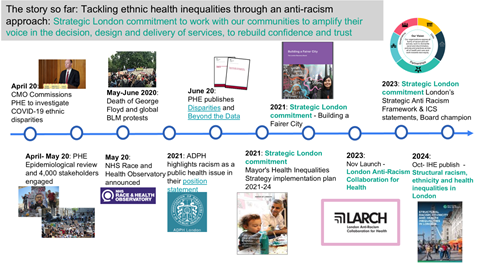
    In 2020, two events prompted an overdue focus on ethnicity related health inequalities and the impact of structural racism – ie. the discrimination and disadvantage built into many of our structures, systems and institutions. The Covid-19 pandemic brought the whole world to a halt, and the national health and care system to the brink of collapse. Almost from the outset, it was clear that Black, Asian and minoritised ethnic Londoners were bearing the brunt of the disease, being more likely to become hospitalised and more likely to die with the Covid-19 virus.

    The pandemic’s devastating impact was heightened by the toll it took on London’s highly diverse health and social care workforce; 45% of NHS staff in London identify as being of Black, Asian, or minoritised ethnic heritage. During the first wave in 2020, 64% of all nurses and support staff who died during the pandemic were from minoritised ethnic groups, with the number rising to 95% for doctors.

    The summer of 2020 also saw the murder of George Floyd, sparking protests across the world and the rise of the Black Lives Matter movement. These protests fuelled new discourse on structural and systemic racism – bringing greater acknowledgement of the negative impacts of social and environmental inequities on many facets of life for minoritised ethnic groups. It also saw greater recognition that designing solutions for these complex problems requires collaboration – not only across sectors, but also in genuine partnership with those most affected by discrimination.

    The response to these events from the health and care sector was wide-ranging. At an operational level, a new wave of co-produced health interventions delivered positive results, with campaigns tackling vaccine hesitancy in Black, Asian and minoritised ethnic groups seeing particular success.


    At a more strategic level, significant developments were also taking place, including:


    ● The Association of Directors of Public Health London (ADPHL) publishing a position statement identifying racism as a public health issue (2021).

    ● Public Health England publishing two major reports into the impact of the pandemic on minoritised ethnic groups, Disparities (2020) and Beyond the Data (2020).


    ● The establishment of the independent NHS Race and Health Observatory (2021).

    Learning from the pandemic and building a more equitable London


    Recognising the urgency of reducing racial health inequalities, the Mayor of London developed a set of major strategic commitments in response..

    The Mayor’s Health Inequalities Strategy Implementation Plan (2021) set out a bold vision for collaborative programmes addressing many of the social determinants that underpin racial health inequalities, as well as a commitment to working with partners to identify further
    targeted action. In parallel, the Building a Fairer City initiative mobilised employers, educational establishments, councils and other bodies to play their part in creating a more equitable London, targeting structural causes of inequality .

    The London Health Board was quick to take on recommended action – appointing a champion for race equity to the Board. With a clear commitment to action across health and care partners – including the NHS, Integrated Care Boards, London Councils, ADPHL and the Mayor of London – a three-pronged approach to London action was taken forward Strategy, evidence and action. This programme was informed by the voices heard to date from a diverse section of London’s communities.

    In 2023, the London partners published the Strategic Framework for Tackling Health Inequalities through An Anti-Racist Approach, an ambitious and action-focused framework setting anti-racist expectations for organisations at every level of health and care. To make sure the evidence for action was crystal clear. in 2024 The Institute of Health Equity, published their landmark evidence review – Structural Racism, Ethnicity and Health Inequalities in London . This review of evidence and interventions gave new voice to the evidence collected over many years by academic, health and voluntary and community sector partners about the importance of tackling racism as a determinant of health. “Tackle racism, discrimination and their outcomes” was cemented as the 7th principle in the well established “Marmot Framework” for action on health inequalities

    Thirdly, was the investment in action. In November 2023 the London Anti-Racism Collaboration for Health (LARCH) was launched, with a focus on supporting and accelerating action across London health and care organisations to tackle health inequalities through embedding anti-racist approaches; turning evidence into action and supporting delivery of the framework Designed in coproduction with communities, the LARCH was developed signed to break down silos and improve collaboration between the people, service and structures that make up London’s health and care ecosystem, and accelerate action across the city. The LARCH will help to drive the anti-racist progress that is so desperately needed by Black, Asian and minoritised ethnic Londoners.

  • Racial health inequalities across London: A summary of the evidence

    Racial health inequalities across London: A summary of the evidence

    Racial health inequalities persist as a significant concern across the UK, with ethnic minoritised communities experiencing disproportionately poorer health outcomes compared to their white counterparts. For instance, Black women are three times more likely to die during pregnancy and childbirth compared to white women. A recent study has found that repeated exposure to racism leads to increased disadvantage and poorer health outcomes throughout life. Despite being one of the UK’s most diverse cities, London is no exception to this rule.

    In London, structural racism continues to affect the health of ethnic minoritised communities. For example, individuals from South Asian backgrounds have been found to have lower participation rates in cancer screening programmes, resulting in delayed diagnoses and poorer outcomes. People from ethnic minoritised groups, who were also born in the UK, suffer the negative repercussions of structural racism too – with the increasing rate of poor health directly correlating with the length of residence in the UK

    While racial health inequalities are a recognised issue in London, there is still very little research that looks clearly at health inequalities in London through the lens of race. As a result, the information in this resource has been brought together from different places, including national health reports, local council and borough documents, and forward planning reports from Integrated Care Boards (ICBs). Together, they help show a wider picture of the inequalities faced by different racial and ethnic groups in London.

    Racial health inequalities in London by disease:

    1. Maternity 
    1. Infectious disease
    1. Diabetes
    1. Cardiovascular disease
    • In Tower Hamlets, there is a high correlation between unemployment and coronary heart disease (CHD), which is most prevalent in the Bangladeshi population. Microsoft Word – CHD JSNA Factsheet
    1. Respiratory disease
    1. Obesity
    1. Mental Health 

    Structural racism and socioeconomic inequalities contribute to higher rates of mental health issues among ethnic minoritised groups.

    • In 2021, the percentage of residents in Lambeth who rate things they do in their life as worthwhile (positive – scores 9–10) was significantly lower amongst Black, Asian, and Multi-Ethnic residents in comparison to white British residents (55% and 74%, respectively). State of the Borough 2022
    • In 2022, London had the largest unemployment rate difference between white people (8%) and people from the Pakistani and Bangladeshi ethnic group (5%). Unemployment – GOV.UK Ethnicity facts and figures
    • Black people (self-identified and officer-observed) are stop and searched 5.5 times more often than white people. The rate is 1.4 times higher for Asians (self-identified) compared to their white counterparts. (Why) do Londoners back stop and search? – StopWatch
    1. Cancer 
    • In Southwest London, those who identify as Black or Asian, with an existing long-term condition, or from the LGBTQI+ community are less likely to come forward with cancer symptoms within 3 months. SWLICBJFP_June2023Final.pdf

    If you are aware of any additional statistics, research, or localised insights that highlight racial health inequalities in London, we encourage you to share them with the Collaboration. Your contributions will help strengthen this resource and support a more accurate, inclusive understanding of the issues at hand.

  • Core Managers Training Programme

    Core Managers Training Programme

    The Core Managers Training Programme is an inclusive leadership course designed to benefit any manager or supervisor working in health or social care in London.

    Originally created by the NHS London Workforce Equality and Inclusion team, the programme consists of online, self-directed training which can be completed flexibly.

    Across six courses, managers on the programme can develop their skills and confidence leading diverse teams in an equitable, inclusive and compassionate way:

    • Inclusive leadership – covering the basics of Equality, Diversity and Inclusion (EDI), the importance of inclusive leadership, and learning and applying inclusive leadership strategies
    • Creating a psychological contract – introducing the concept of psychological contracts and introducing them in the workplace
    • Noticing and challenging microaggressions – identifying microaggressions and their consequences for teams and individuals, and developing a toolkit to respond to these issues
    • Effective allyship – learning how to support and champion marginalised groups
    • Increasing disability positivity – exploring the legal concept of disability, challenging outdated models of disabilities and understanding the vital role of the line manager in supporting colleagues with disabilities
    • Leading inclusivity: LGBTQIA+ essentials – understand the history of the LGBTQIA+ movement, reflect on intersectionality and use this knowledge to foster inclusivity at work and drive social change

    Each of the course is available free to anyone working in an NHS, public health or social care role. You can apply on the NHS Leadership Academy website.

  • Co-production: resources to support anti-racist transformation projects

    Co-production: resources to support anti-racist transformation projects

    Working in equal partnership with the people and communities affected by racial health inequalities is essential to create sustainable change and improvement in health and care services and systems.

    Involving people and communities in transformation projects brings a number of benefits, including:

    • Ensuring that projects focus on the underlying cause of a problem rather than simply addressing a symptom;
    • Including the perspectives, creativity and expertise of the people most affected by inequalities;
    • Building trust and relationships with communities who have historically been poorly treated by the health and care system.

    Many health and care organisations also have a statutory requirement to involve people in change projects.

    Co-production resources

    Co-production is the term used to describe the closest form of lived experience partnership, wherein professionals and people with lived experience plan, develop and own projects together.

    “Co-production acknowledges that people with ‘lived experience’ of a particular condition are often best placed to advise on what support and services will make a positive difference to their lives. Done well, co-production helps to ground discussions in reality, and to maintain a person-centred perspective.”

    NHS England

    A growing range of strategies, templates and other resources are becoming available to support co-production, including those with a particular anti-racist focus.

    Below, we have listed some of the resources already being used by members of the Collaboration:

    With thanks to everyone who has shared resources as part of the Collaboration.

    Got a great resource you’d like to share with us? Get in touch!